Sangemini Spring
The water that made the village famous: medium-mineral, bicarbonate-calcium and low in sodium, bottled since 1889 and historically drunk at the spring as part of the drinking cures.
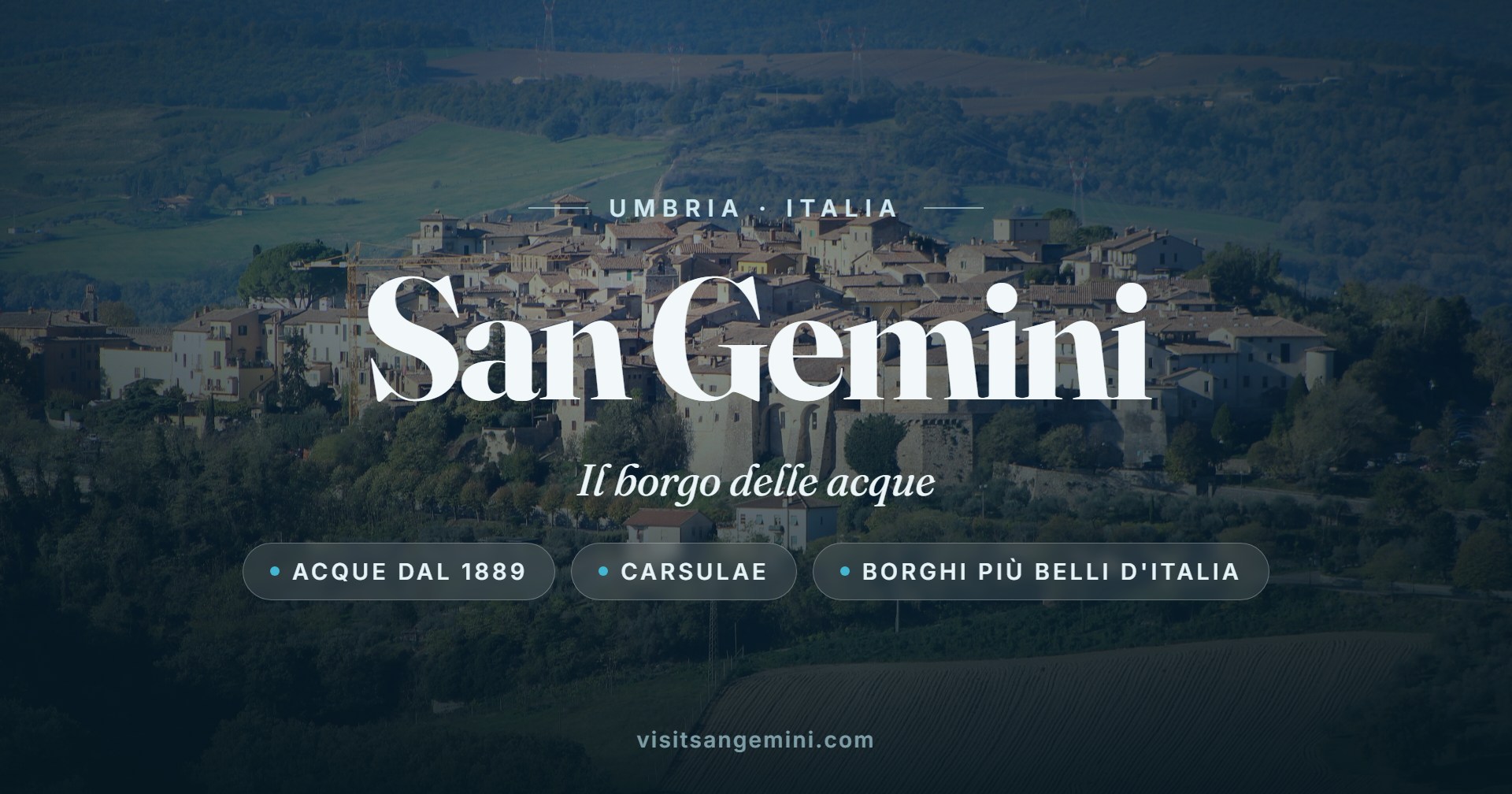
The Umbrian village of waters: springs known since Roman times, a stone-built medieval borgo listed among the Borghi più Belli d'Italia (Italy's most beautiful villages) and the Roman city of Carsulae on the Via Flaminia.
Run a local business? Create your landing page on the SaaS platform →From the slopes of Monte Torre Maggiore rise the Sangemini and Fabia springs, known since Roman times. In 1838 came the first scientific analyses; in 1889 the village's water began to be bottled and the Parco delle Fonti was inaugurated, bound for more than a century to the story of the village.
The water that made the village famous: medium-mineral, bicarbonate-calcium and low in sodium, bottled since 1889 and historically drunk at the spring as part of the drinking cures.
The twin spring: low-mineral and ice cold, traditionally drunk from the spout according to the village's custom.
Between the 19th and 20th centuries the drinking cures brought visitors to the village from all over Italy: the "season of the waters" is part of San Gemini's history.
Local history outreach: the composition and characteristics of the waters are drawn from labels and historical literature. The portal does not manage the springs, the spas or the Parco delle Fonti and does not sell their services: for access, prices and official information, refer to the operators and producers.
"Sangemini" and "Fabia" appear on this page only as place names and historical designations of the springs: no reference is intended to homonymous commercial brands, which belong to their respective owners.
Between its two rings of walls open stairways, arches and artistic treasures: from the medieval churches to the palaces of the free commune, as far as the nearby village of Cesi. Eight stops to get to know it.
The monumental 18th-century gateway commissioned by the Santacroce princes: the grand staircase that introduces the village, between historic palaces and workshops.
Dedicated to the patron saint and rebuilt in Neoclassical style between 1817 and 1847 with the support of Antonio Canova, who stayed here: beneath the high altar rest the saint's relics.
The Saint stayed in San Gemini in 1213. The Gothic church preserves 15th-century frescoes of the Umbrian school and a precious wooden crucifix.
Symbol of the medieval free commune: the majestic great arch, the frescoed Orsini coats of arms and, beside it, the Esperia tower with its bell cast in 1318.
A masterpiece of Umbrian Romanesque architecture mentioned in 1036: its original portal now stands in the Metropolitan Museum of Art in New York; inside, the 1295 Madonna by Rogerino da Todi.
The village's drawing room, where local life comes together: San Gemini's heart between the Gothic church and the 18th-century town hall, with cafés and shops.
A few kilometres away, at the foot of Monte Torre Maggiore, the mountain that feeds San Gemini's springs: a medieval village with intact walls, stone alleyways and views over the valley, and the gateway to the mountain trails.
A Romanesque facade dated 1199 with a Cosmatesque portal and little lions: born as a baptistery and once octagonal in plan, it stands beside the ancient walls.
A Roman municipium on the Via Flaminia, laid out in the Augustan age and abandoned after ancient landslides: the ground protected it for centuries. Today you walk among the ruins of a real city, beneath the Umbrian sky.
From Roman Casventum to the village of the monk Gemine, from the fiefdoms of the Orsini and the Santacroce to the worldwide fame of its water: the story of San Gemini flows like its springs.
Casventum: along the Via Flaminia stands a Roman house with rich mosaics, preserved today in via del Tribunale.
The Syrian monk Gemine preaches and helps the community: the village takes his name, Santo Gemine.
Saracen raids raze the settlement to the ground; it rises again higher up, around the monastery.
First mention of "Sanctum Geminum" in the founding act of the Abbey of San Nicolò.
San Gemini becomes a free commune under the protection of Pope Honorius III, breaking free from Narni.
An Orsini fief since 1530, it is raised to a duchy: the lordships that follow adorn the village.
The Santacroce princes build the new circuit of walls and the monumental Porta Romana.
Pius VI grants San Gemini the title of city.
Bottling begins and the Parco delle Fonti is born: the village's water wins over Italy.
San Gemini is among the Borghi più Belli d'Italia and a town of the Cittaslow network: the slow life of the waters.
A calendar that runs through all the seasons: re-enactments in arms, flowers on the stones and summer evenings within the walls. Dates and programmes are indicative and set year by year: always check the official channels.
The village splits into the Rocca and Piazza districts: candle offerings, the investiture of knights, a historical procession and taverns, leading up to the horse race that crowns the winning district. The cycle traditionally draws to a close around 9 October, the feast day of the patron saint.
The streets of the centre are covered with carpets of petals and dried flowers, prepared for months by the people of San Gemini: compositions that mark the path of the procession.
Music, theatre and open-air evenings among squares and courtyards: the festival that carries the village through the summer.
Itineraries, guides, events, promotions and services: content from the portal and the businesses of San Gemini and Umbria.
7 Settembre 2026
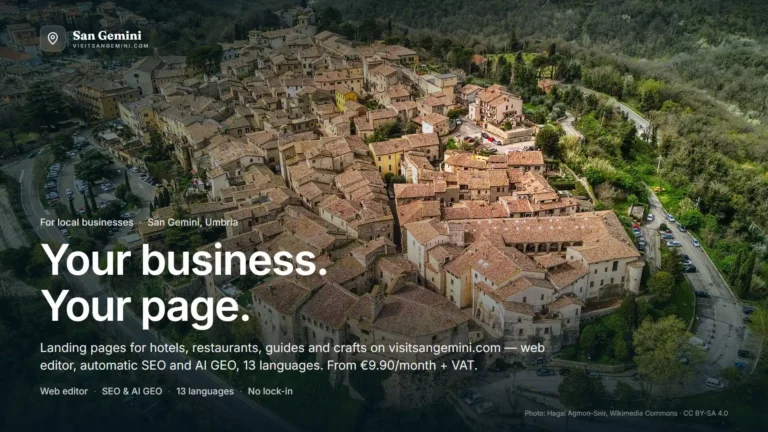
If you run a hotel, a restaurant, a guide service or a craft workshop in San Gemini and the surrounding...
Discover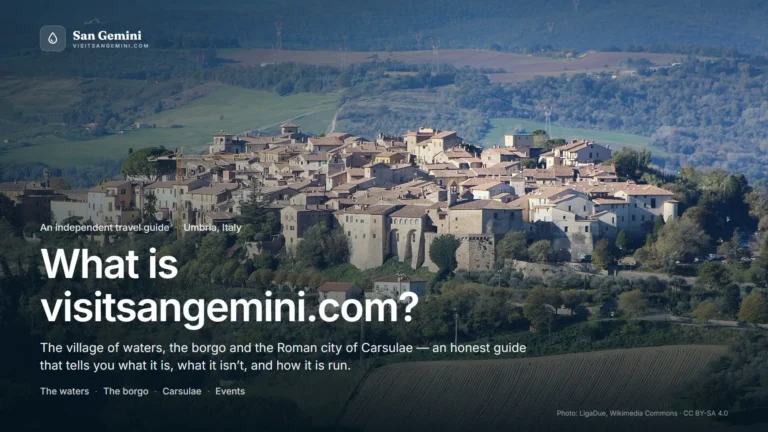
7 Settembre 2026
If you're planning a trip to Umbria and you've landed on this page, a fair question deserves a straight answer:...
DiscoverSign up, build your page with the web editor and publish articles, posts, services, offers and menus in front of those planning their visit. Automatic SEO and AI GEO, an interface in 13 languages, everything from the browser, no app.
Perfect as a stop between Rome and the heart of Umbria, a short hop from Terni, Narni and the Marmore Falls.
Opening hours of places of interest and monuments change with the seasons: always check before you visit.